
Schuyler Released Mugshot Records
A booking photo is created during an arrest or custody intake. Its continued display says nothing certain about present status. Schuyler's official Recent Bookings cards combine a photo with name, booking date, booking agency, charges, and remarks, but the inspected cards do not show release date, release type, or a clear current-versus-released label.
Illinois law does not make every image automatically open or permanently public. 5 ILCS 140/2.15 contains criminal-history provisions, exemptions still apply, and subsection 2.15(e) restricts law-enforcement social-media publication for specified low-level matters. The Arrest Reports Act has a related limitation. Request the exact booking photo and ask for segregable release information if the image is withheld.
Schuyler Released Photo Channels
Use the source tied to the custody episode. A county-only booking and an IDOC prison record can show different photographs taken at different times. Registry and VINE images have still other purposes.
| Channel | Photo status | How to use it |
|---|---|---|
| Schuyler Recent Bookings | Verified photos on booking cards | Match booking agency and date; confirm release separately |
| Sheriff mobile app | Roster access announced; photo and released tab not verified | Inspect the current app before relying on a feature |
| Sheriff records request | May produce a booking photo, subject to law and exemptions | Request by person, booking, and date range |
| IDOC profile | Can display a state identification image | Use only for a person committed to IDOC |
| VINELink | May show an agency-supplied image | Treat as reporting-agency data, not a permanent archive |
| ISP registry | Official identifying image for qualifying registrants | Do not relabel it a mugshot unless the source does |
| RecentlyBooked | Nonofficial Schuyler booking mirror | Discovery clue only; verify every fact with the sheriff |
The BOP locator's generic silhouette is not a prisoner's booking photo. Local weekly reports may contain case material but do not form a released-photo archive.
Schuyler Sheriff App Photos
The sheriff announced a full move from the website to the official Schuyler County Sheriff IL app effective July 22, 2026. The announcement confirms inmate information and jail-roster access. It does not establish that the app has a released tab, a photo archive, a 24-hour window, or stable photo retention.
The App Store listing records the official app source.
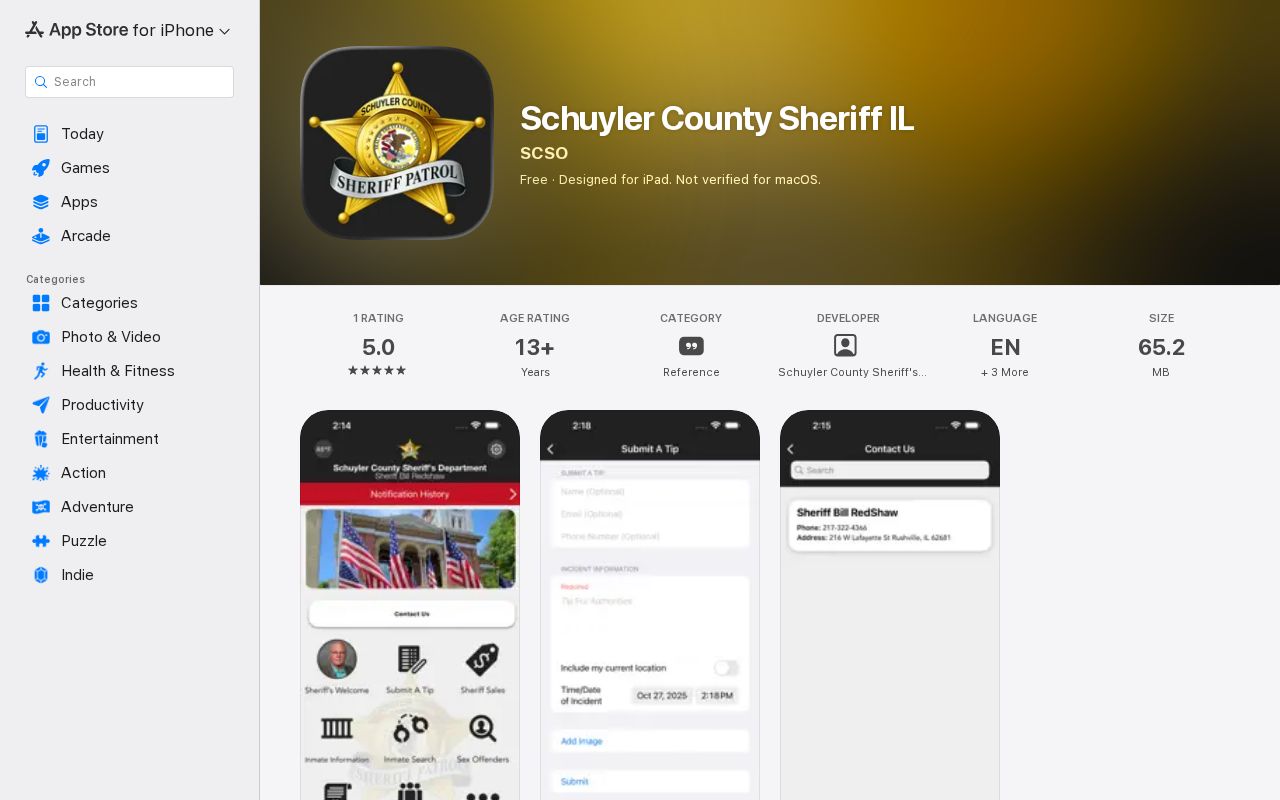
Check the installed version and date before describing any menu. The 24-Hour Release List explains why roster removal cannot be converted into a same-day release claim.
Request Schuyler Booking Photos
A written Illinois FOIA request is the durable fallback when the public card is gone. The county FOIA page links a coroner-specific PDF, not a general sheriff jail-record form. Send a plain, reasonably specific request to the Sheriff's Office and call first to confirm its current submission route.
- Identify the full name, approximate booking date, booking agency, and date range.
- Request the booking photograph plus the booking and release transaction. Include release date and time, type or disposition, and receiving agency for a transfer if disclosable.
- Ask for electronic copies and segregable nonexempt portions if some material is withheld.
- Ask the office to identify the exemption used for any denial and to advise before fees are incurred.
- Keep the request, proof of delivery, response, and the date each image was obtained.
216 West Lafayette Street
Rushville, IL 62681
Jail: 217-322-4366
County FOIA directory: 217-322-4367
Illinois FOIA ordinarily allows five business days for a noncommercial request and permits a written five-business-day extension in defined circumstances. That deadline does not promise the image will be disclosed. A narrow request reduces disputes and leaves unrelated private material out.
Nonofficial Schuyler Mugshot Mirrors
RecentlyBooked's Schuyler page mirrors arrest-focused booking material. It is not an official release source. A preserved photograph can outlast the sheriff card, but its dates, charges, and status must be checked against the sheriff and court.
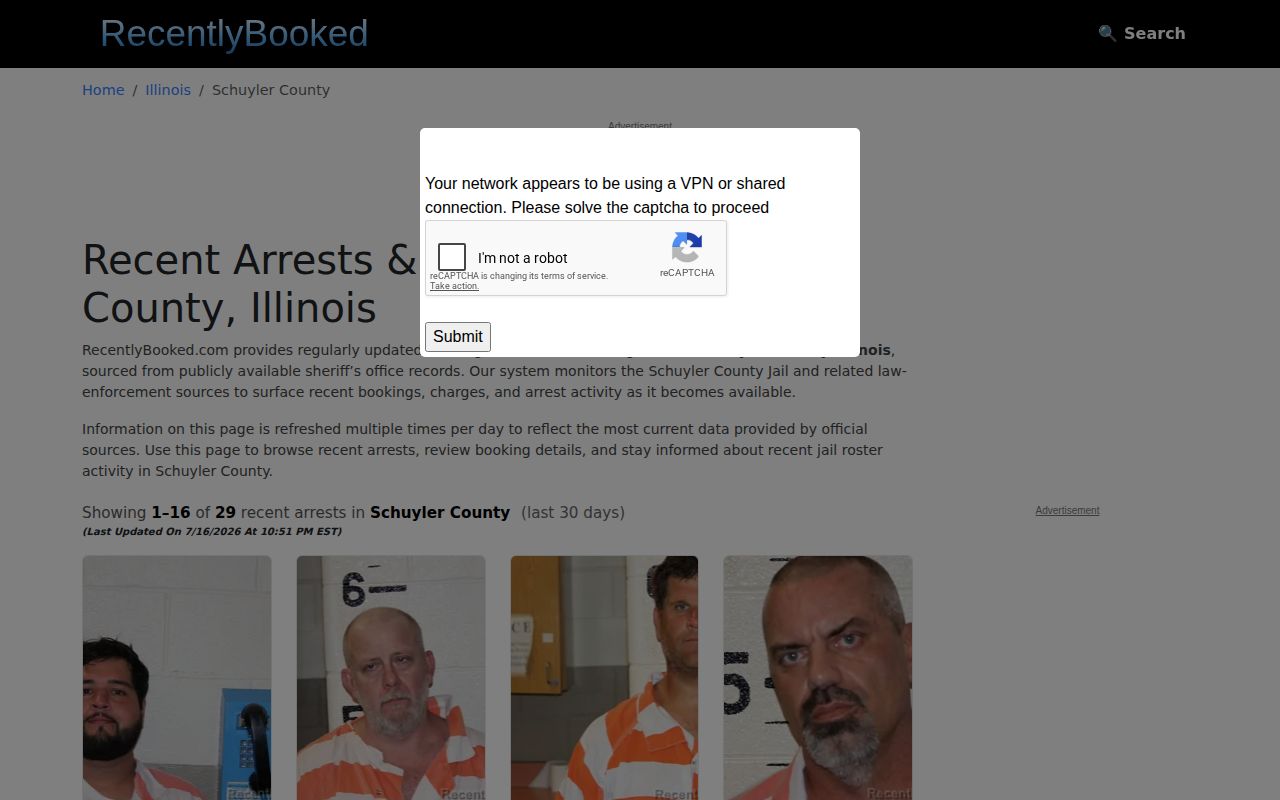
The mirror can help locate an older image. It cannot prove that a person was released, transferred, convicted, or remains in custody.
Sheriff weekly reports publish arrests, warrants, citations, and a daily detainee average. Some use cite-and-release language. Those reports provide local context, not an individual released-photo archive. An arrest entry may not lead to a jail booking, while a booking card may concern another county because Schuyler houses outside jurisdictions.
Schuyler Mugshot Correction Rights
Illinois's 815 ILCS 505/2QQQ bars a publisher or disseminator of criminal-record information from soliciting or accepting payment to remove, correct, or modify it. Covered for-profit publishers must correct errors within five business days after notice, subject to statutory exceptions. Document the disputed field, the source record, the requested correction, and any demand for payment.
Expungement and sealing are later court processes, not release proof or simple photo-removal requests. The Schuyler Circuit Clerk posts standardized forms, a $60 petition fee, and $10 per certification of an entered order. Verify current fees before filing. Eligibility and legal effects come from 20 ILCS 2630/5.2.
Even after an order, online changes may take time and each custodian must comply under the applicable process. A live IDOC result disappearing after sentence completion is not proof of expungement. Likewise, a missing sheriff card does not show that a court sealed the case.
Schuyler Roster Photo Limits
The official Schuyler sheriff roster and weekly-report page visibly shows photos on Recent Bookings cards.
The same cards show booking facts but omit verified release date, time, type, destination, and status. Their presence is not proof of custody.
No official released-photo archive or retention policy was found. Record the booking agency before following up. A card naming Cass or Brown County can reflect a person housed in Schuyler for another jurisdiction, so the controlling court or agency may hold the legal disposition while Schuyler holds the movement record.
If a card disappears, request both the photo and release transaction. If IDOC later shows the person, describe the change as county-to-state transfer rather than community release. The Schuyler County released-inmate search provides the full cross-system confirmation path.
Caption any retained image with its source and booking date. State that it is the photograph associated with that booking and that an arrest is not a conviction. Avoid copying unnecessary identifiers or private contact information. A later IDOC image may look different because it belongs to a separate state intake, while a registry image exists for a statutory identification purpose.
Photo correction and custody correction also follow separate paths. Send a mistaken sheriff image or booking field to the Sheriff's Office custodian. Send an IDOC profile issue to IDOC, and direct a VINE problem to the reporting facility that supplied the data. A third-party mirror cannot amend the government record, even if it removes its copy.
Images from other systems need careful labels. An IDOC photograph belongs to a state corrections record and may have been taken long after the county booking. A VINE image comes from its reporting agency. An Illinois registry image serves a statutory registration purpose and should not be renamed a jail mugshot unless the source says so. The BOP locator's generic silhouette is not a person's photograph. These differences prevent separate custody episodes from being blended together.
Before connecting a photo to a released person, carefully compare the name with the booking date, agency, case number, and another stable identifier when lawfully available. Schuyler's regional housing makes the agency field vital. Preserve the source URL and capture date, and do not crop away the agency label. If identity remains uncertain, request the official booking record instead of relying on facial resemblance or a commercial mirror. Keep the photo request separate from the release request so a returned image is never mistaken for proof of release. The jail transaction, receiving-agency entry, and court disposition remain the evidence for custody movement.