
Schuyler Projected vs Actual Release
A projected date is a calculation based on the current sentence record. It can support planning, but it is not proof that someone passed out of custody on that day. The actual release is an agency transaction. For state prison, IDOC distinguishes a prison release or Parole Date from a later Projected Discharge Date. For Schuyler County Jail, the sheriff's release or transfer entry records the physical movement.
Pretrial detention has no sentence-based projection. Departure can follow a bond or pretrial order, dismissal, or other authority, but processing and holds still matter. A county sentence also should not be calculated from an IDOC profile unless the person was committed to state corrections.
| Date or status | What it means |
|---|---|
| Parole Date | Public IDOC indicator of departure from prison into parole or MSR |
| Projected Discharge Date | Estimated end of IDOC sentence and supervision jurisdiction |
| County release date/time | Jail transaction documenting departure or transfer |
| Court release order | Legal authority in that case, not proof that all custody ended |
Find Schuyler Projected Release Dates
Begin by identifying the custody track. Schuyler County Jail holds local and other-jurisdiction detainees, while IDOC manages state prison sentences. The booking agency and committing county prevent a Cass or Brown County case from being mistaken for a Schuyler sentence.
- Check the current sheriff booking card and record the booking agency, booking date, charge, and remarks. The card itself has no verified release-date field.
- For state custody, open the IDOC Individual in Custody Search and search by surname, IDOC number, or birth date.
- Open the matched profile. Read Offender Status, Admission Date, Parole Date, Projected Discharge Date, and each sentence row.
- For a county sentence, obtain the sentencing order and custody-credit entry from the Schuyler Circuit Clerk, then ask the jail for its calculation or release transaction.
- Record the date and time of every lookup. Confirm the actual event through the releasing agency after the displayed date.
The official IDOC search form shows the available search routes.
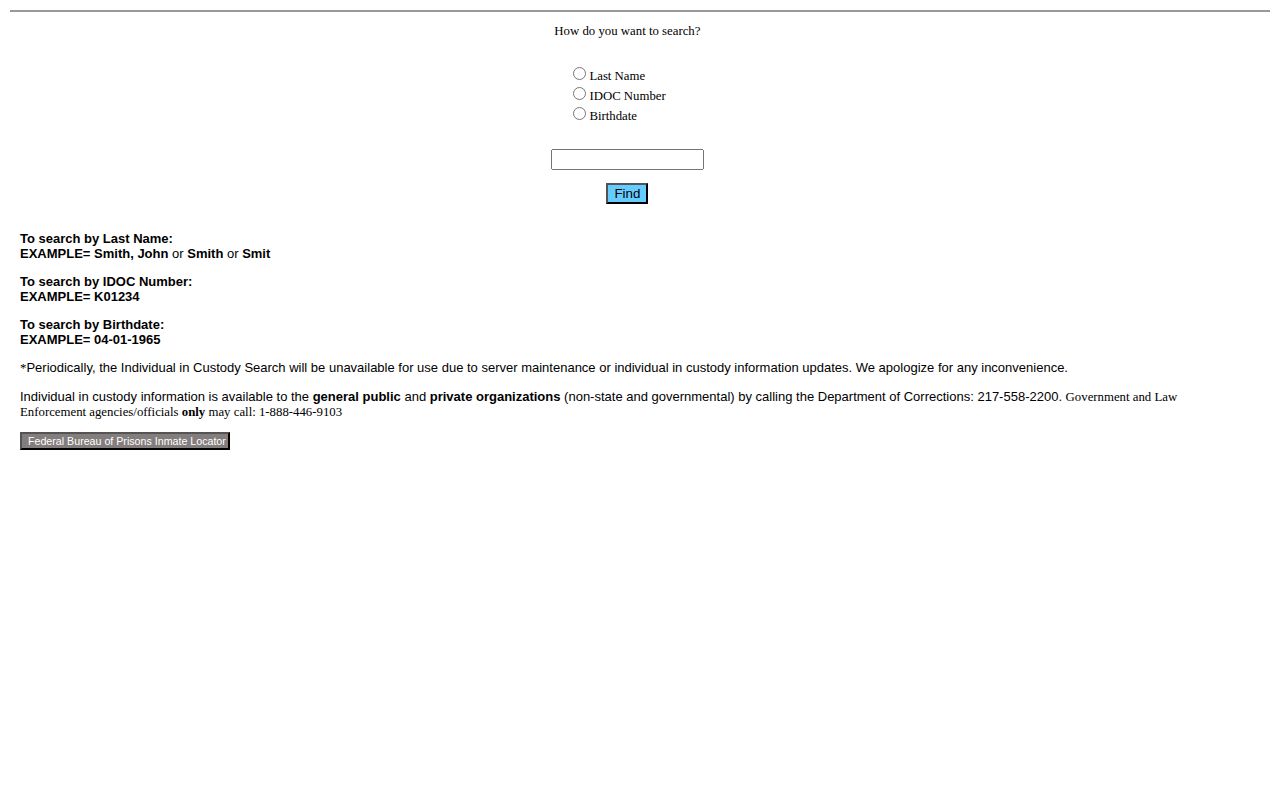
A unique IDOC number is the strongest starting field. Partial surname searches should be narrowed with birth date and sentence details.
Illinois Credit Changes Schuyler Dates
IDOC begins with the sentence, custody date, and pre-sentence jail credit. It then applies the correct statutory credit rate under 730 ILCS 5/3-6-3. Illinois has no single rule that everyone serves 85 percent. Baseline eligible sentences may earn one day of credit for each day served, while specified categories can require about 75 percent, about 85 percent, or 100 percent.
The conviction statute and offense date determine the subsection. A charge label is not enough. IDOC also describes discretionary Earned Sentence Credit of up to 180 days for eligible people, but it says an individual award cannot be predicted. Credit loss through discipline, later restoration, and corrected jail credit can all change a projected date.
The official Illinois sentence-credit statute is captured below.
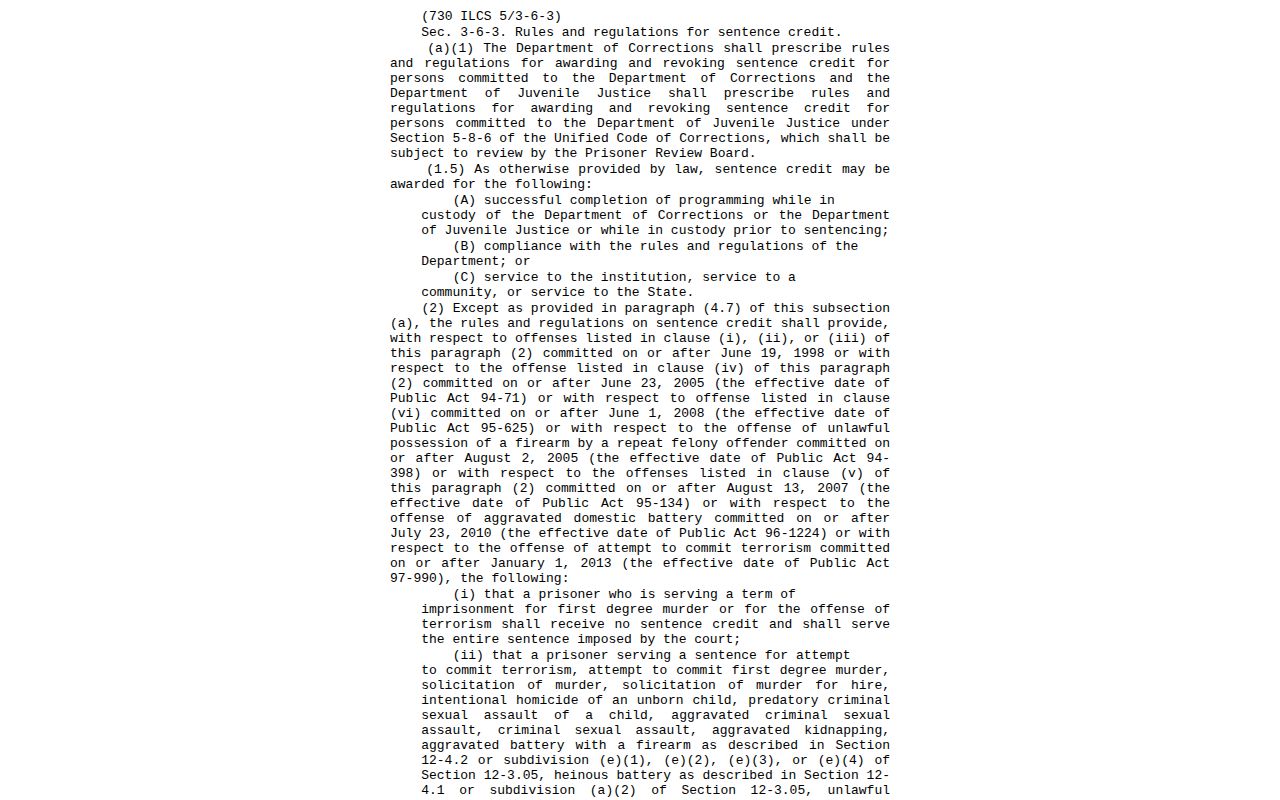
The statute must be matched to the judgment and offense date before estimating time.
Why Schuyler Release Dates Change
A displayed date reflects the records and credits then in force. New legal events or corrections can move it. Never preserve a screenshot without also preserving the date checked.
| Factor | Possible effect | Where to confirm |
|---|---|---|
| Credit award, loss, or restoration | Moves the projected prison-exit calculation | IDOC profile and sentence record |
| Corrected jail credit | Changes credited time already served | Court order and IDOC calculation |
| Concurrent or consecutive correction | Changes how multiple terms combine | Sentence rows and committing court |
| New court order or vacatur | Changes the legal sentence basis | Certified court record and IDOC update |
| Detainer or other hold | Can prevent community departure after one case ends | Holding and receiving agencies |
| Parole or PRB decision | Can grant, deny, defer, or address revocation in eligible cases | PRB result plus IDOC status |
Multiple sentence counts require care. A row marked Sentence Discharged? YES does not end custody or supervision if another count remains active. Likewise, a parole district is an administrative location and should not be published as a residence.
Confirm Schuyler County Release
An IDOC profile can show how the state labels status and dates. The official IDOC public result example demonstrates those fields without making a claim about a Schuyler detainee.
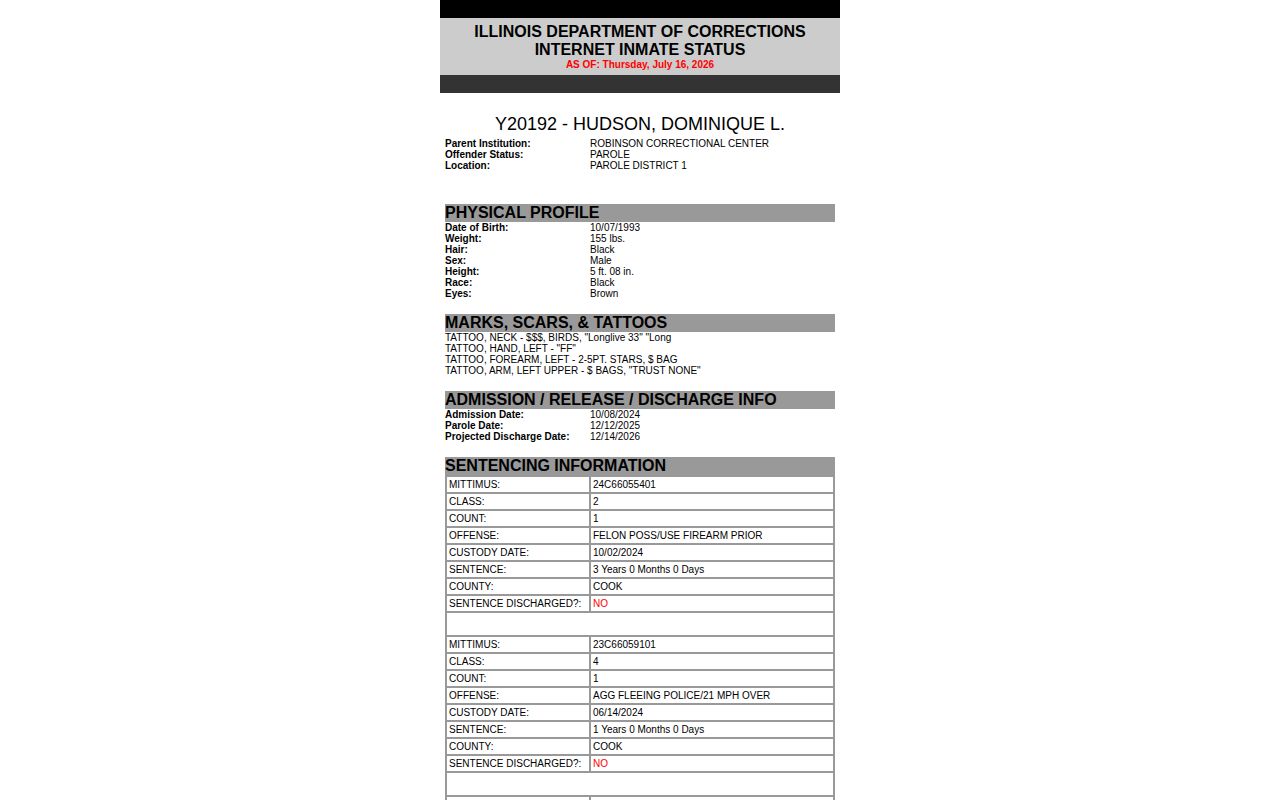
Read Parole Date and Projected Discharge Date separately. Pair the profile with each sentence row and the date the record was checked.
VINELink Check can provide a custody-change alert where the reporting agency participates, but it does not calculate a projected date. When an alert arrives, reopen the matched record and call the reporting facility. A release message may still require confirmation that the event was community release rather than transfer.
For Schuyler County Jail, call 217-322-4366 and identify the exact booking. Ask whether the custody episode ended, the event date and type, and any receiving agency that can be disclosed. A documentary answer should come from a narrow written request for the release or transfer transaction.
Older Schuyler Release Date Records
IDOC's live search covers people incarcerated or on parole. A person who completed the full sentence can disappear from live results even though an archived state record remains. Try spelling variants, a known IDOC number, and birth date before concluding that the record is absent.
For an old Illinois prison term, use IDOC Contact Us and select Record Search. Supply the full name, date of birth, year received, institution if known, committing county, and relevant dates. A focused IDOC FOIA request can seek releasable identifying, admission, release, and sentence information. The committing-county court file can supply the mittimus and later orders.
A judicial sentence end date and an agency's actual release date answer different questions. Preserve both when they differ. Corrections should go to the source that owns the disputed field rather than choosing whichever date appears more favorable.
Schuyler County Jail Date Calculation
A person serving county time needs a local calculation. The 2024 jail inspection checks compliance with the County Jail Good Behavior Allowance framework, but it does not publish a person-specific Schuyler formula. Obtain the written sentencing order, custody-credit entries, and any later court changes. Then ask the Sheriff's Office for its release calculation or completed transaction.
No verified Schuyler policy promises a Friday release when a sentence ends on a weekend, and no public local schedule sets release hours. Do not import a rule from another county. Ask how the jail recorded the event and whether another jurisdiction controlled the person's next destination.
The Schuyler County Jail record page covers local release and transfer requests. The general Schuyler County released-inmate lookup connects jail, court, IDOC, and notification channels when the custody path is unclear.
Regional housing adds one more check. Schuyler may hold someone booked by Cass, Brown, or another jurisdiction. In that case, Schuyler can document physical departure while the other court or agency controls the sentence and legal authority. Record the booking agency before requesting a date. A transfer back to that agency ends the Schuyler stay but does not establish freedom.
Use exact language in notes and requests. “Projected prison release,” “Parole Date,” “Projected Discharge Date,” “court-ordered release,” and “actual jail release transaction” are not interchangeable. Precise labels make later changes easier to audit and keep supervision from being mistaken for the end of the sentence.
A pretrial detainee has no sentence-based projected date. Departure depends on a court order, release conditions, dismissal, and clearance of other holds. For county time, ask for the custody-credit entry rather than applying an IDOC rule by analogy. If staff give an estimate orally, note who supplied it and when, then obtain the completed transaction after the event. Court paperwork, a new warrant, medical movement, or an outside-agency pickup can change what happens on the expected day.
VINELink can send a status-change alert, but it does not calculate a sentence or promise a door-exit time. Keep each projected date with the date checked and the agency that published it. After the event, use the release or transfer entry as proof of what occurred. This preserves the difference between planning information and a completed custody record. When two systems disagree, ask each record holder to explain its own field rather than selecting the earlier date. Record the explanation in writing when possible.